Growth science · Nutrition
Calcium, vitamin D, zinc & iron: which growth nutrition co-factors actually matter?
Calcium, vitamin D, zinc and iron are the four nutrients most often sold to parents as the path to a taller child. All four are genuinely essential — a serious deficiency in any of them can hold a child back. But "essential" and "height booster" are not the same thing, and the gap between them is where a lot of money is spent for nothing.
Here is the principle the whole evidence base supports, in one line:
So the useful question isn't "which supplement makes kids taller?" — none reliably does in a well-nourished child. It's "is my child actually short of anything, and if so, which one?" This guide answers that for all four, with the intakes children need, what the trials really show, and how to tell a genuine gap from clever marketing.
1. Growth is never controlled by one nutrient
Linear growth is a system. It needs enough total energy, enough good-quality protein, a healthy endocrine system, normal growth-plate function, calcium and phosphate, vitamin D metabolism, thyroid and growth-hormone signalling, normal puberty, oxygen delivery, and freedom from significant chronic illness. A micronutrient shortfall can become one limiting factor in that system — but once a requirement is met, more of that nutrient does not push growth further.
A systematic review of 69 nutrition-intervention studies in children two years and older found exactly this pattern: effects on height varied enormously by the intervention, the child’s starting nutritional status, and the population. Nutrients helped most when children were deficient, poorly fed, or growth-restricted — and much less when they were already adequately nourished.[1] That single distinction runs through everything below:
- Preventing deficiency is evidence-based.
- Treating a diagnosed deficiency is evidence-based.
- Promising extra height in a nutritionally sufficient child is not.
2. What children actually need each day
These are the US National Academies’ Recommended Dietary Allowances used by the NIH Office of Dietary Supplements.[12][13][14][15] National figures vary slightly, and they represent total daily intake from food, fortified products and any supplement combined — a child rarely needs a pill delivering the full amount when food already covers part of it.
| Age | Calcium | Vitamin D | Zinc | Iron |
|---|---|---|---|---|
| 1–3 years | 700 mg | 600 IU (15 mcg) | 3 mg | 7 mg |
| 4–8 years | 1,000 mg | 600 IU (15 mcg) | 5 mg | 10 mg |
| 9–13 years | 1,300 mg | 600 IU (15 mcg) | 8 mg | 8 mg |
| Boys 14–18 | 1,300 mg | 600 IU (15 mcg) | 11 mg | 11 mg |
| Girls 14–18 | 1,300 mg | 600 IU (15 mcg) | 9 mg | 15 mg |
The higher iron figure for teenage girls covers menstrual loss. Needs shift with restricted diets, illness, blood loss or malabsorption.
3. Calcium — mineral strength, not direct height
About 99% of the body’s calcium sits in bones and teeth, and childhood is when the skeleton is laying down peak bone mass. That makes calcium essential — but bone mineral density and bone length are different outcomes. A child can gain bone mineral without gaining height.
Randomised trials bear this out: calcium supplementation produces only a small increase in bone mineral — statistically real, concentrated at the upper limb, largely gone once supplementation stops, and judged clinically minor for fracture risk.[2] It is not a reliable height treatment for a calcium-sufficient child, which is why the American Academy of Pediatrics emphasises meeting calcium needs through diet rather than routine supplements.[3]
Where calcium genuinely matters for growth is at the low end: severely inadequate intake impairs mineralisation and can cause nutritional rickets — and in populations on very low-calcium diets, that can happen even without profound vitamin D deficiency.[4]
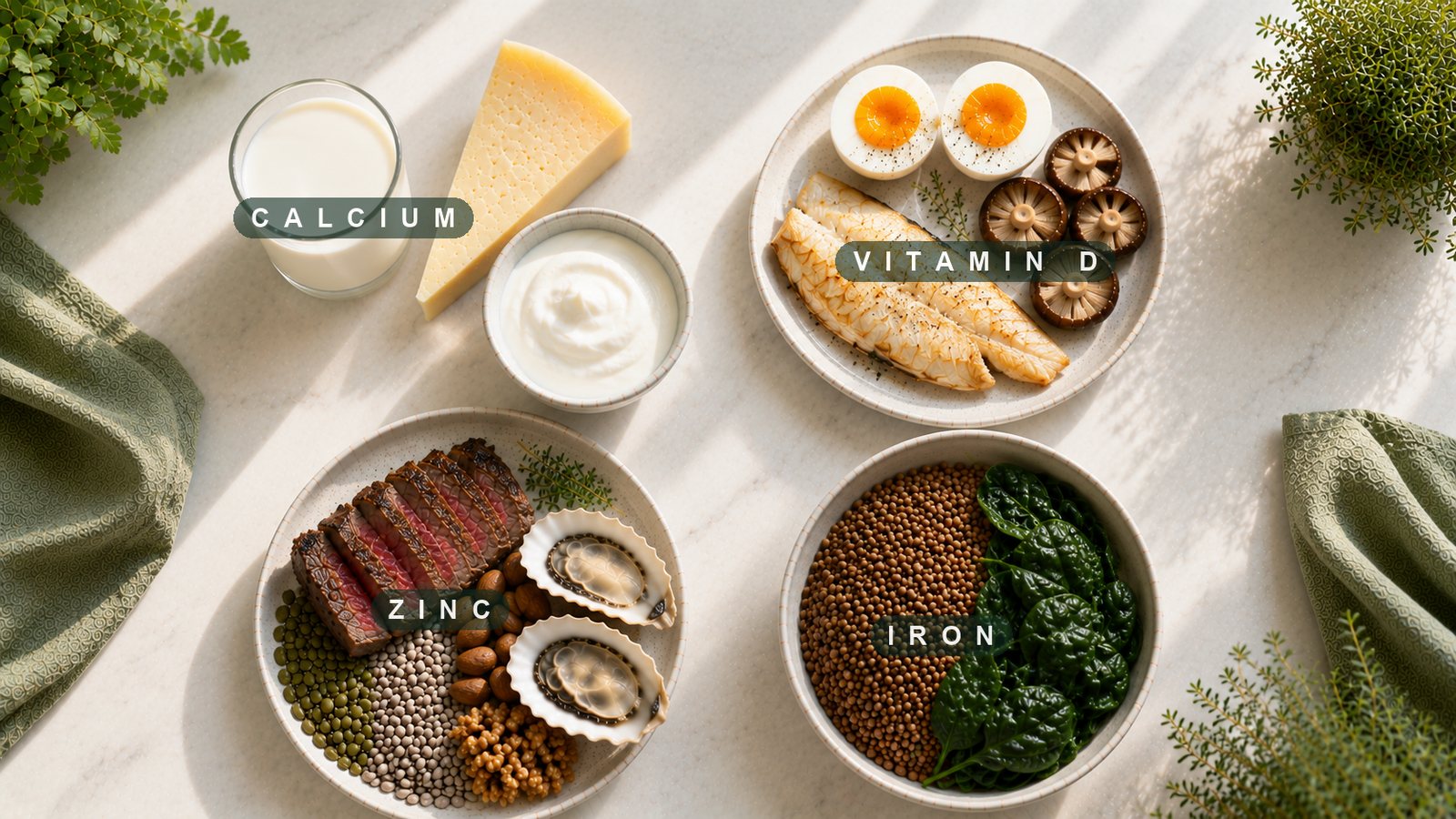
Good sources: milk (~275–300 mg/cup), fortified soy milk (often ~300 mg), yoghurt, hard cheese, calcium-set tofu, sardines with bones, fortified foods, and dark-green vegetables (amount and absorption vary). Fortified plant “milks” differ wildly — check the label for calcium, vitamin D, protein and added sugar rather than assuming every “milk” is equivalent. Higher-risk children: those who avoid dairy without a fortified alternative, cow’s-milk allergy, restrictive vegan or elimination diets, very low overall intake, or malabsorption.
4. Vitamin D — essential for bone, not a general height enhancer
Vitamin D lets the body absorb calcium and phosphate and maintain the mineral environment bone needs. Severe deficiency causes rickets — soft, poorly mineralised bone and growth plates, bowed legs, widened wrists, bone pain, muscle weakness, delayed motor development. Preventing that is one of the clearest wins in child nutrition, and infant supplementation (commonly 400 IU/day, especially for breastfed babies) is strongly recommended by paediatric authorities.[4]
But treating deficiency is not the same as adding height in a child who is already replete. The highest-quality evidence is consistent:
- A Cochrane review found oral vitamin D probably makes little or no difference to linear growth or stunting versus placebo.[5]
- Randomised trials in schoolchildren — including a three-year trial in 8,851 children where 96% were vitamin-D-deficient at baseline — improved vitamin D status but did not improve height, body composition, or pubertal development.[6][7]
Sources are limited naturally — oily fish (salmon, trout, sardines, mackerel), egg yolk, small portions of liver, UV-exposed mushrooms — plus fortified milk, formula, some plant beverages, cereals and yoghurt (fortification varies by country). Routine blood testing of healthy, symptom-free children isn’t recommended; test when there are signs of rickets, recurrent low-trauma fractures, malabsorption, liver or kidney disease, or relevant medications. And more is not safer: excess vitamin D can cause hypercalcaemia, kidney stones and injury — toxicity comes almost entirely from over-dosing supplements, so high-dose weekly or monthly products should never be improvised for a child.
5. Zinc — the micronutrient closest to linear growth
Zinc drives cell division and protein synthesis — the exact processes behind height gain — so of the four, it has the strongest claim to a direct growth effect. It also supports immunity, appetite and sexual maturation, and significant deficiency can cause growth failure, poor appetite, frequent infections and slow wound healing (all non-specific signs that shouldn’t be self-diagnosed).
Crucially, the benefit tracks deficiency:
- A 2023 Cochrane review concluded preventive zinc may lead to a small increase in height, most likely to outweigh harms where zinc deficiency is common.[8]
- A 2023 meta-analysis found zinc significantly improved height, weight and height-for-age — across populations with varying deficiency risk.[9]
- WHO’s and the intervention-review evidence both note the growth effect is greater in stunted children than in well-nourished ones.[1][8]
So zinc is not “the height nutrient” for every child — it’s the nutrient most likely to help a child who is short of it. Sources: oysters and shellfish (richest), red meat and poultry (well absorbed), eggs, dairy, beans, lentils, nuts, seeds and fortified cereals. Animal zinc absorbs better; phytates in whole grains and legumes reduce absorption, though soaking, sprouting and fermenting help. And more is not better — chronic high-dose zinc blocks copper absorption and can cause copper-deficiency anaemia, so children shouldn’t take adult “immune” lozenges continuously without a clinician’s review.
6. Iron — for oxygen and the brain, not for height
Iron builds haemoglobin to carry oxygen, and supports muscle oxygen, energy metabolism, and — critically — brain development, attention and learning. Deficiency runs along a spectrum: stores fall, then tissue supply drops, then haemoglobin falls into iron-deficiency anaemia. A child can have depleted iron stores before becoming anaemic.
Iron treatment clearly fixes iron status and haemoglobin when a child is deficient. Its effect on height is not convincing: a systematic review of randomised trials found no statistically significant positive effect of iron supplementation on any growth measure.[10] Iron can indirectly help a deficient child eat, play, learn and move normally again — but it is not a height supplement, and shouldn’t be sold as one.
Higher-risk children: premature or low-birth-weight infants, toddlers drinking excessive cow’s milk (which displaces iron-rich foods — a reason paediatric guidance limits milk volume in young children[11]), low-meat or unplanned vegetarian diets, and teenage girls with heavy periods. Sources: heme iron (beef, lamb, poultry, fish, shellfish) absorbs best; non-heme iron (lentils, beans, tofu, fortified cereal, dark greens) absorbs better with vitamin C (lentils + tomato, tofu + broccoli, cereal + berries) and worse with tea or coffee at the meal.
7. When a supplement is genuinely worth it
Supplementation is well supported in specific, identifiable situations — not as a blanket “height” strategy:
- Infancy vitamin D — commonly recommended for breastfed and partially breastfed babies, per national guidance.[4]
- A confirmed deficiency — iron, vitamin D or zinc, treated at a dose set by age, weight, labs and cause (therapeutic doses can differ a lot from ordinary reference intakes).
- Restricted diets — vegan diets, multiple food allergies, medical elimination diets, or severe selective eating, when a carefully reviewed diet can’t reliably deliver a nutrient.
- Malabsorption or chronic disease — coeliac disease, IBD, cystic fibrosis, liver or kidney disease; managed medically.
- Public-health programmes — in populations with high deficiency rates, WHO supports fortification and micronutrient powders.[16] That addresses a documented population risk — it is not evidence that every well-fed child needs the same product.
8. When a supplement is being oversold
Be sceptical of any product that claims to:
- add a specific number of centimetres, or guarantee height from testimonials and before/after photos;
- “activate” or “reopen” growth plates, or work after they’ve fused;
- raise growth hormone without medical treatment;
- work regardless of diet or puberty;
- fix several deficiencies at once with no testing or dietary review;
- be superior simply because it contains calcium, zinc and vitamin D together.
9. Food first: a one-day pattern
A good diet doesn’t maximise every nutrient at every meal — it gives repeated opportunities across the day. This is an illustration, not a prescription; exact needs depend on age, appetite, allergies and culture.
| Meal | Example | Contributes |
|---|---|---|
| Breakfast | Two eggs, whole-grain toast, a cup of milk or fortified soy, fruit | Protein, calcium, vit D (if fortified), zinc, iron |
| Lunch | Beef, chicken, fish, tofu or beans + rice/pasta/potato + vegetables | Zinc, iron, protein, calcium |
| Snack | Yoghurt or cheese + fruit; or hummus with vegetables; nuts/seeds where safe | Calcium, protein |
| Dinner | Salmon or meat or tofu + a calcium-containing or fortified side + a vitamin-C vegetable | Vit D, iron, calcium, absorption boost |
That single day supplies meaningful amounts of all four nutrients — no “height supplement” required. The goal is adequacy, not perfection.
10. Safety: the upper limits parents forget to count
The recommended intake and the safe upper limit are not the same number, and the upper limit is a ceiling, not a target. Approximate tolerable upper intakes from all sources combined:[12][13][14][15]
| Age | Calcium | Vitamin D | Zinc | Iron |
|---|---|---|---|---|
| 1–3 years | 2,500 mg | 2,500 IU | 7 mg | 40 mg |
| 4–8 years | 2,500 mg | 3,000 IU | 12 mg | 40 mg |
| 9–13 years | 3,000 mg | 4,000 IU | 23 mg | 40 mg |
| 14–18 years | 3,000 mg | 4,000 IU | 34 mg | 45 mg |
The trap is stacking: a gummy multivitamin, a separate mineral tablet, fortified milk, a nutrition shake and an “immune” product can quietly push a child over a safe level. Count every source. (Clinicians may use higher therapeutic doses to treat a documented deficiency under supervision — that’s different from routine intake.)
11. When growth needs more than a supplement
A supplement should never delay medical assessment. See a clinician if a child has height below roughly the 2nd–3rd percentile, height velocity that is slowing or crossing percentiles downward, unexplained weight loss, chronic gut symptoms, persistent fatigue or pallor, bone pain or deformity, delayed or unusually early puberty, recurrent fractures, or a chronic illness. Short stature is often not a nutrient deficiency at all — familial short stature, constitutional delay, being born small for gestational age, coeliac or thyroid disease, and growth-hormone disorders all look similar from the outside. A supplement can close an intake gap; it cannot diagnose why a child is growing slowly.
12. A parent’s checklist before buying
Ask, in order:
- Which specific gap or deficiency is this treating?
- How much does my child already get from food and fortified products?
- Is the dose right for their age — and does it duplicate another vitamin or shake?
- Is there evidence for the finished product, or only its ingredients?
- Is a bone-health finding being spun as a height claim?
- Could it interfere with another nutrient or medicine?
- Do the symptoms or growth pattern actually need a clinician?
- Has the product been independently tested for content and contamination?
See the gap before you reach for a pill
GrowSense tracks your child's protein, calcium and zinc against the same age- and sex-based targets used in this article — from everyday food — so a genuine shortfall is something you can see, not guess. It labels what's measured versus estimated, follows the whole growth trajectory, and never promises centimetres from a supplement.
Explore GrowSenseThe bottom line
Calcium builds bone mineral. Vitamin D lets the body use calcium and phosphate. Zinc powers the cell division behind linear growth. Iron carries oxygen and builds the brain. All four matter — because deficiency matters. But beyond adequacy, none of them is a proven way to make a healthy child taller.
The evidence-based approach is unglamorous and it works: feed a varied, adequate diet; follow infant vitamin-D guidance; notice the children with restricted intake or medical risk; test selectively when there’s a real reason; treat confirmed deficiencies at the right dose; watch the whole growth curve over time; and walk past anything promising guaranteed height in a bottle.
References
A. How nutrients affect growth
- Roberts JL, Stein AD. The impact of nutritional interventions beyond the first 2 years of life on linear growth: a systematic review and meta-analysis. Adv Nutr. 2017;8(2):323–336. PMID: 28298275.
B. Calcium & bone
- Winzenberg T, Shaw K, Fryer J, Jones G. Calcium supplementation for improving bone mineral density in children. Cochrane Database Syst Rev. 2006;(2):CD005119. PMID: 16625624.
- Golden NH, Abrams SA; AAP Committee on Nutrition. Optimizing bone health in children and adolescents. Pediatrics. 2014;134(4):e1229–e1243. PMID: 25266429.
- Munns CF, Shaw N, Kiely M, et al. Global consensus recommendations on prevention and management of nutritional rickets. J Clin Endocrinol Metab. 2016;101(2):394–415. PMID: 26741135.
C. Vitamin D
- Huey SL, Acharya N, Silver A, et al. Effects of oral vitamin D supplementation on linear growth and other health outcomes among children under five years of age. Cochrane Database Syst Rev. 2020;12(12):CD012875. PMID: 33305842.
- Ganmaa D, Stuart JJ, Sumberzul N, et al. Vitamin D supplementation and growth in urban Mongol school children: results from two randomized clinical trials. PLoS One. 2017;12(5):e0175237. PMID: 28481882.
- Ganmaa D, Bromage S, Khudyakov P, et al. Influence of vitamin D supplementation on growth, body composition, and pubertal development among school-aged children: a randomized clinical trial. JAMA Pediatr. 2023;177(1):32–41. PMID: 36441522.
D. Zinc
- Imdad A, Rogner J, Sherwani RN, et al. Zinc supplementation for preventing mortality, morbidity, and growth failure in children aged 6 months to 12 years. Cochrane Database Syst Rev. 2023;3(3):CD009384. PMID: 36994923.
- Monfared V, Salehian A, Nikniaz Z, et al. The effect of zinc supplementation on anthropometric measurements in healthy children over two years: a systematic review and meta-analysis. BMC Pediatr. 2023;23(1):414. PMID: 37612628.
E. Iron
- Sachdev H, Gera T, Nestel P. Effect of iron supplementation on physical growth in children: systematic review of randomised controlled trials. Public Health Nutr. 2006;9(7):904–920. PMID: 17010257.
- Baker RD, Greer FR; AAP Committee on Nutrition. Diagnosis and prevention of iron deficiency and iron-deficiency anemia in infants and young children (0–3 years of age). Pediatrics. 2010;126(5):1040–1050. PMID: 20923825.
F. Reference intakes & guidance
- NIH Office of Dietary Supplements. Calcium: Health Professional Fact Sheet. Bethesda, MD: National Institutes of Health.
- NIH Office of Dietary Supplements. Vitamin D: Health Professional Fact Sheet. Bethesda, MD: National Institutes of Health.
- NIH Office of Dietary Supplements. Zinc: Health Professional Fact Sheet. Bethesda, MD: National Institutes of Health.
- NIH Office of Dietary Supplements. Iron: Health Professional Fact Sheet. Bethesda, MD: National Institutes of Health.
- World Health Organization. Use of multiple micronutrient powders for point-of-use fortification of foods consumed by infants and young children. Geneva: WHO.
This article is educational and does not diagnose micronutrient deficiency or set an individual supplement dose. Children with poor growth, restrictive eating, chronic illness, suspected anaemia, bone symptoms, or other clinical concerns should be assessed by a qualified pediatric healthcare professional.