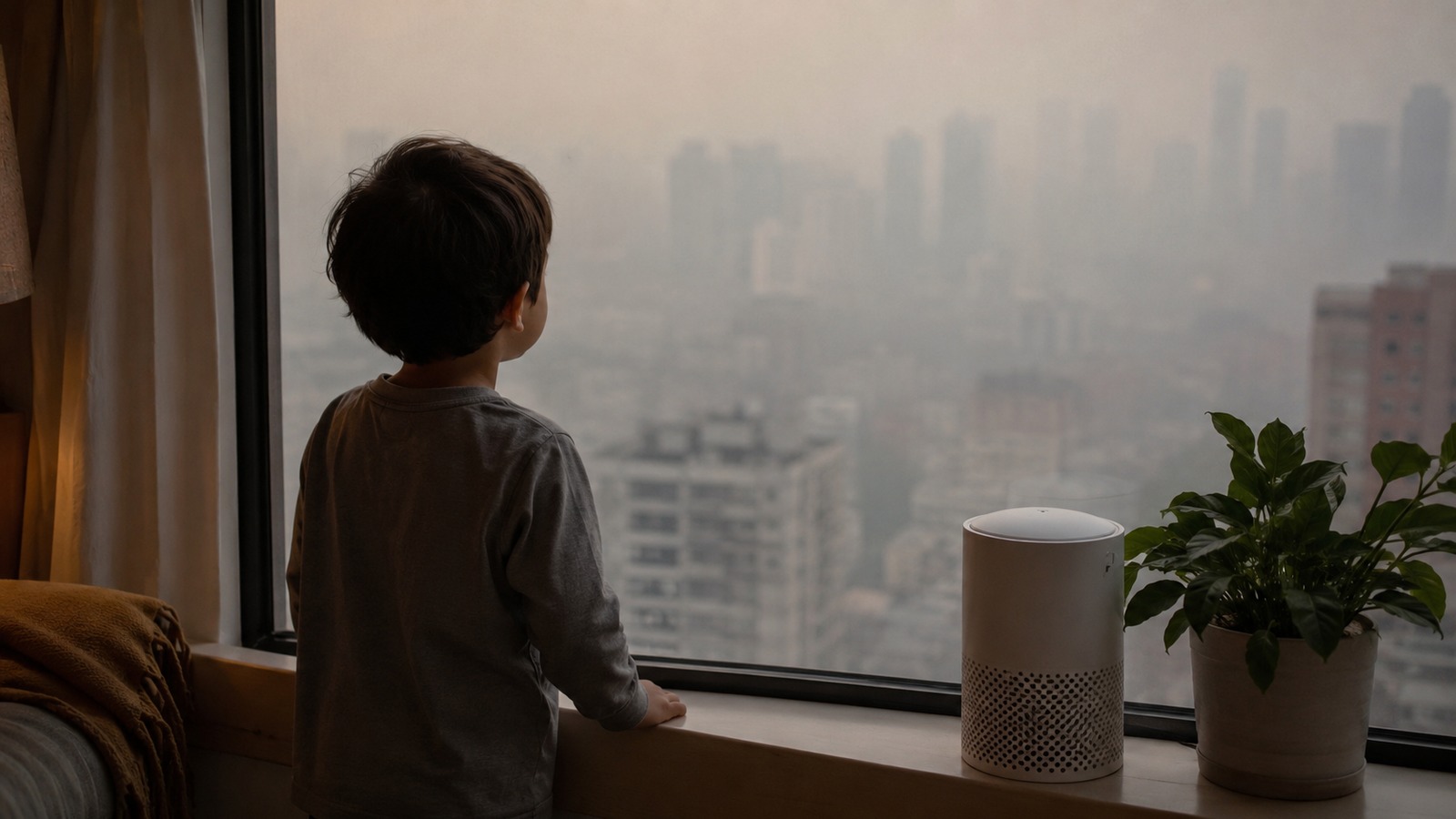
Growth science · Environment
Air Pollution, PM2.5, and Child Growth: Can Dirty Air Slow Height Gain?
A child doesn't have to cough or wheeze for dirty air to reach the body. Fine particles enter the lungs, trigger inflammation, and can influence blood vessels, the placenta, metabolism and immunity. In pregnancy, higher exposure has been linked with lower birth weight and impaired fetal growth; through childhood, studies tie air pollution to stunting, altered weight trajectories, poorer lung development and — in some populations — slightly shorter height. But the evidence needs careful wording: pollution is not a height switch, a high-PM2.5 week can't be turned into a number of millimetres "lost," and most studies can't fully separate pollution from poverty, nutrition, infection and housing.[1]
The honest conclusion: air pollution can make the biological environment for growth less favourable — most of all when exposure starts in pregnancy, stays high for years, or combines with infection, poor nutrition and chronic respiratory disease. For a growth tracker, PM2.5 belongs on the timeline as a meaningful exposure, never as a centimetre calculator.
It alters trajectories — it doesn't shrink a child. Standing height does not fall during a smoky week; no individual centimetre can be pinned to one episode. The concern is a subtler change in the *rate and quality* of growth over months and years.
The evidence is strongest early. The clearest links are to reduced fetal growth and smaller birth size, and to stunting-related outcomes in heavily exposed young children — that outdoor PM2.5 independently lowers the final height of an otherwise healthy, well-nourished child is far less certain.[1]
Sometimes it's weight, not height. Some studies link exposure to rapid weight gain, higher BMI or central adiposity rather than lower weight[11] — more weight is not healthier growth, so height, weight and BMI must be read as separate trajectories.
1. What PM2.5 is, and why children are more exposed
PM2.5 is airborne particulate matter 2.5 micrometres across or smaller — from vehicle exhaust, coal and industry, wildfire and crop-burning smoke, construction dust, household cooking fuels, waste burning and secondary atmospheric reactions. It’s small enough to reach deep into the lungs, and some components enter the circulation or provoke body-wide responses. The WHO uses it as the central marker of harmful air and recommends an annual mean no higher than 5 µg/m³ and a 24-hour mean no higher than 15 µg/m³ — health-based guidelines, not thresholds below which risk is zero.[3]
Children aren’t small adults. Relative to size they breathe more air, have developing lungs, spend more time active (inhaling more deeply during play), have immature immune and detoxification systems, and can’t choose where they live or go to school — often exposed for years during sensitive windows. WHO estimates the overwhelming majority of the world’s children breathe air above its guideline levels, making pollution a widespread developmental exposure, not a problem of a few visibly smoggy cities.[2]
2. Does PM2.5 make children shorter? It depends on the life stage
There’s a plausible relationship, but it differs by stage. The evidence is strongest for reduced fetal growth and smaller birth size; higher stunting risk in heavily exposed young children; altered weight and body-composition trajectories; and respiratory illness plus impaired lung growth that indirectly affect development.
An early British-cohort study found children’s height inversely associated with outdoor coal-burning pollution, though the authors stressed the mechanism and causality were uncertain.[7] A later systematic review and meta-analysis found consistent links between both ambient and household air pollution and stunting-related outcomes in early life — arguing clean air belongs in integrated stunting prevention alongside nutrition, infection control and maternal health.[1] So the fair reading is: pollution may suppress or alter growth trajectories, especially in vulnerable children — but it rarely acts alone.
3. The first sensitive window: before birth
A child’s growth exposure begins in pregnancy, where the fetus depends on the placenta for oxygen, glucose, amino acids, fats, micronutrients and vascular support. Air pollution may interfere through oxidative stress, inflammation, endothelial dysfunction and changes in placental blood flow. A pooled analysis of prenatal PM2.5 found associations with lower birth weight after accounting for differences between cohorts,[4] and personal-monitoring work linked the oxidative potential of PM2.5 with lower birth weight and length — suggesting particle composition and reactivity may matter as much as total mass.[5]
This matters because babies born small-for-gestational-age or growth-restricted start with less reserve and may need catch-up afterward — the catch-up story itself is covered in born small and catch-up growth.
4. “Growth” is not one number
Pollution can influence birth weight, length/height, weight-for-height, BMI, fat distribution, head circumference and lung growth — and not always in the same direction. Recent studies link prenatal PM2.5 to higher BMI trajectories or accelerated early-childhood growth in some populations,[9][10] lower childhood weight with particular PM2.5 components in others,[8] and a dose-response link with obesity measures — especially central obesity — in a large study of children and adolescents.[11]
None of this means pollution helps children grow. A child can gain weight fast while linear growth stays modest; more adiposity is not healthier skeletal development. Pollution-associated metabolic disruption can produce a less favourable body composition even as the scale rises — which is exactly why height, weight and BMI must be tracked as separate trajectories.
5. How dirty air could interfere with growth
Several pathways are biologically plausible and often overlap:
| Pathway | How it could affect growth |
|---|---|
| Systemic inflammation | Particles activate inflammatory signalling in lung and blood — which can blunt appetite, raise energy expenditure, alter insulin sensitivity, lower liver IGF-1 and create relative GH resistance, echoing (more subtly) the growth suppression of chronic inflammatory disease. |
| Oxidative stress | PM2.5 generates reactive oxygen species or carries metals/organics that damage the placenta, blood vessels, mitochondria and endocrine signalling — the rapidly dividing fetus and young child are especially sensitive. |
| Recurrent respiratory illness | WHO flags impaired lung development, infection and aggravated asthma as major consequences; repeated illness cuts appetite and activity, disturbs sleep, adds fever/inflammation and school absence — so a height effect may show months after a cluster of events, not the day of one bad reading. |
| Asthma & medication burden | PM2.5 is tied to more childhood asthma and wheezing (pregnancy and the early years look most sensitive)[13] — recurrent attacks and cumulative oral-steroid bursts add another indirect route (see asthma inhalers & growth). |
| Sleep disruption | Cough and nasal irritation fragment sleep, and a major GH pulse follows sleep onset; one polluted night doesn't cost measurable height, but repeated disruption worsens the environment for growth and recovery (see does sleep affect height). |
| Less outdoor activity & sunlight | Long pollution seasons and air-quality cancellations cut aerobic and bone-loading exercise and UVB/vitamin D opportunity — but the fix is cleaner indoor movement, never sending a child into hazardous air. |
Air pollution should not be reduced to “a vitamin D problem” — that’s one small strand of a broader story.
6. Ambient versus household air pollution
Outdoor PM2.5 gets the headlines, but indoor and household sources can create equal or greater exposure: cooking with wood, charcoal, coal or dung; tobacco smoke; incense; mosquito coils; candles; unventilated gas combustion or frying; and outdoor smoke drifting in. A systematic review linked household air pollution with early-life stunting, especially in lower-resource settings where it combines with maternal undernutrition and infection,[1] and a study of Ethiopian under-fives reported poorer linear growth with household air pollution (observational, so residual social and nutritional confounding remains possible).[12] For many families, “staying indoors” does not guarantee clean air.
7. Practical protection: air days, masks, purifiers
Is there a “safe” AQI for outdoor play? AQI is a communication scale, not a universal biological dose, and categories vary by country — follow local health-authority guidance, especially for children with asthma, heart or lung disease, babies, those recovering from infection, or any child who develops symptoms on exertion. The practical rule: the worse the air and the harder the child breathes, the greater the inhaled dose. A gentle walk and a competitive football session are not the same inhaled dose at the same PM2.5, because sport greatly increases ventilation — so move high-intensity exercise indoors when levels are unhealthy.
On a high-PM2.5 day: check a trustworthy local source before the routine starts; move vigorous activity indoors (dance, skipping, body-weight circuits, indoor court, stationary cycling); close windows and use car recirculation, opening up later when levels improve; remove indoor sources (no smoking, incense, candles, coils, unventilated frying; vent the extractor hood outdoors); keep the prescribed asthma controller going — pollution may raise the need for prevention, not lower it; and protect the constants pollution shouldn’t disturb — bedtime, protein, calcium and vitamin D, hydration, indoor movement and height monitoring.
8. How long would a growth effect take to appear?
Different outcomes move on different clocks — which is why parents shouldn’t expect height to drop during a haze episode:
Standing height does not decrease because of PM2.5. The concern is the slow change in the rate of development — and why some studies find rapid weight gain or obesity rather than stunting: pollution can disrupt metabolism (smaller fetal size → rapid weight catch-up → higher BMI, central adiposity, lower lean mass, relatively preserved height) rather than uniformly suppressing growth. Studies also differ in population nutrition, pollution composition, exposure timing, child sex and methods. So “pollution makes children short” is too narrow; more accurately, pollution can alter growth trajectories — sometimes restricted linear growth, sometimes unhealthy weight gain, sometimes both at different ages.
9. When growth concerns need medical review
Arrange a pediatric assessment when height velocity stays low over 6–12 months; height crosses downward through percentiles; weight also falls; respiratory illness repeatedly disrupts eating or sleep; asthma needs repeated oral steroids; there’s chronic cough or exercise intolerance; there’s persistent fatigue; the birth history included fetal-growth restriction; or growth doesn’t recover once respiratory health improves. Clinicians should work through ordinary medical and nutritional causes rather than assume pollution explains everything.
10. Questions parents actually ask
Can PM2.5 affect child growth?
Probably yes — most clearly before birth and in early childhood, where it's linked with fetal-growth restriction, stunting-related outcomes and altered weight trajectories.[1]
Does one polluted week stunt height?
No — no measurable individual height loss can be assigned to a short episode, and standing height doesn't fall because of smoky air.
Is the effect direct?
Partly direct (inflammation, oxidative stress, placental dysfunction) and partly indirect (respiratory illness, poor sleep, medication, less outdoor activity).
Does pollution always make children smaller?
No — some studies link exposure with rapid weight gain or obesity rather than lower weight.[11]
Should kids exercise outside in unhealthy air to protect growth?
No. Lung safety first — move activity indoors and keep sleep and nutrition normal.
Can a purifier solve it?
It reduces indoor exposure when used correctly, but can't eliminate every source (school transport, outdoor play).
Should I stop the asthma inhaler on bad-air days?
No — pollution can raise the need for prevention. Follow the asthma action plan and seek care if breathing is hard.
How this connects
Air pollution is the widest-angle version of a rule that runs through every growth question: a curve is read over time and in context, never from one number or one bad week. The honest signal isn’t “PM2.5 cost 0.6 cm” — uncomputable for one child — but a pattern: a smoky stretch coinciding with night cough, an oral-steroid course, lost sleep and missed activity, and then a velocity that dips over the following months. That chain — pollution → symptoms → sleep → medicine → activity → trajectory — is far more meaningful than treating PM2.5 as an isolated figure.
Put PM2.5 on the timeline — beside symptoms, sleep, medicine and activity
GrowSense keeps air pollution where it's useful: a contextual layer behind growth, sleep, activity and illness — daily outdoor PM2.5 and AQI category, time outdoors and exercise intensity, mask and purifier use, cancelled school activity, and household smoke sources — recorded alongside cough, wheeze, reliever use, controller changes and any oral-steroid courses. That lets a real chain surface (high-PM2.5 stretch → more night cough → less sleep → a steroid burst → lower activity), and it deliberately won't claim "PM2.5 reduced your child's growth by 0.6 cm." Instead it flags the honest thing — an environmental stressor present during this interval — and points you to the 6–12-month height trajectory, not one smoky day. Clean air isn't a growth supplement; it's part of the basic environment in which healthy growth becomes possible.
Explore GrowSenseWhat parents should take away
Dirty air can tilt the environment for growth the wrong way — clearest before birth and in early childhood, through inflammation, placental stress, illness, lost sleep and less outdoor play — but it rarely acts alone, and it alters trajectories rather than shrinking a child (a smoky week never lowers standing height). Sometimes that shows as restricted linear growth, sometimes as unhealthy weight gain. So track height, weight and BMI separately over months; cut exposure where you can (a bedroom purifier, closed windows on bad days, no indoor smoke, activity moved indoors); keep asthma treatment, sleep and nutrition steady through pollution season; and when a curve genuinely slows, look at the whole child — don’t let “it’s the pollution” stand in for a proper medical and nutritional review.
References
A. Overviews and guidance
- Pun VC, Dowling R, Mehta S. Ambient and household air pollution on early-life determinants of stunting — a systematic review and meta-analysis. Environ Sci Pollut Res Int. 2021;28(21):26404–26412. PMID: 33835342.
- World Health Organization. Air Pollution and Child Health: Prescribing Clean Air. Geneva: WHO; 2018.
- World Health Organization. WHO Global Air Quality Guidelines: PM2.5, PM10, Ozone, Nitrogen Dioxide, Sulfur Dioxide and Carbon Monoxide. Geneva: WHO; 2021.
B. Before birth: fetal growth
- Rosa MJ, Pajak A, Just AC, et al. Prenatal exposure to PM2.5 and birth weight: a pooled analysis. Environ Int. 2017;107:173–180. PMID: 28738263.
- Borlaza LJS, Uzu G, Ouidir M, et al. Personal exposure to PM2.5 oxidative potential and its association with birth outcomes. J Expo Sci Environ Epidemiol. 2023;33(3):416–426. PMID: 36369373.
- Clemente DBP, Casas M, Vilahur N, et al. Prenatal ambient air pollution exposure, infant growth and placental mitochondrial DNA content. Environ Res. 2017;157:96–102. PMID: 28535425.
C. Childhood growth, weight and BMI
- Bobak M, Richards M, Wadsworth M. Relation between children's height and outdoor air pollution from coal-burning sources in the British 1946 birth cohort. Int Arch Occup Environ Health. 2004;77(6):383–386. PMID: 15338223.
- Sun X, Liu C, Liang H, et al. Prenatal exposure to residential PM2.5 and its chemical constituents and physical growth from birth to age two. Environ Int. 2021;154:106580. PMID: 33905944.
- Zhou S, Li T, Han Y, et al. Prenatal exposure to PM2.5 and its constituents with children's BMI trajectory in the first three years. Environ Res. 2023;232:116326. PMID: 37271439.
- Zhou S, Li T, Han Y, et al. The joint effects of prenatal exposure to PM2.5 constituents on accelerated childhood growth. J Expo Sci Environ Epidemiol. 2025;35(4):502–510. PMID: 38532124.
- Tong J, Ren Y, Liu F, et al. The impact of PM2.5 on the growth curves of children's obesity indexes. Front Public Health. 2022;10:843622. PMID: 35392463.
D. Household air pollution and respiratory burden
- Mulat E, Tamiru D, Abera M, et al. Impact of indoor air pollution on the linear growth of children under five in Ethiopia. BMC Public Health. 2024;24:488. PMID: 38365615.
- Chen G, Zhou H, Zhang W, et al. Effect of early-life exposure to PM2.5 on childhood asthma/wheezing. Pediatr Allergy Immunol. 2022;33(6):e13816. PMID: 35754133.
This article is educational and does not diagnose your child or assess their growth. Standing height does not fall because of a smoky week — no individual centimetre can be assigned to a pollution episode, and most studies cannot fully separate air pollution from poverty, nutrition, infection and housing. Never send a child to exercise in unhealthy air to 'protect growth' — lung safety comes first — and never stop a prescribed asthma controller because the air is bad. If breathing becomes difficult, seek care. Questions about a child's growth, breathing or environment belong with your pediatrician; concerns about a child's safety in severe pollution belong with local health authorities.