Growth science · Activity
How much exercise does a child actually need?
Parents are usually handed one tidy number: 60 minutes, every day. It lands like a nightly quota — an hour of continuous exercise, seven days a week, pass or fail. That is not what the guideline means, and reading it that way turns a busy Tuesday into a failure it was never meant to be.
For children and adolescents aged 5–17, the World Health Organization recommends an average of at least 60 minutes per day of moderate-to-vigorous activity across the week, most of it aerobic, with vigorous, muscle-strengthening and bone-strengthening activity on at least three days each week.[1][2] The load-bearing word is average. This guide unpacks what that actually asks of a week — and why the kind of movement matters as much as the minutes.
The reframe that removes most of the guilt. The target is a weekly average, not a stopwatch test each night. A child who does 45 minutes on a school day, 100 during weekend sport, and short active bursts in between is meeting it — the pattern is what counts, not any single date.
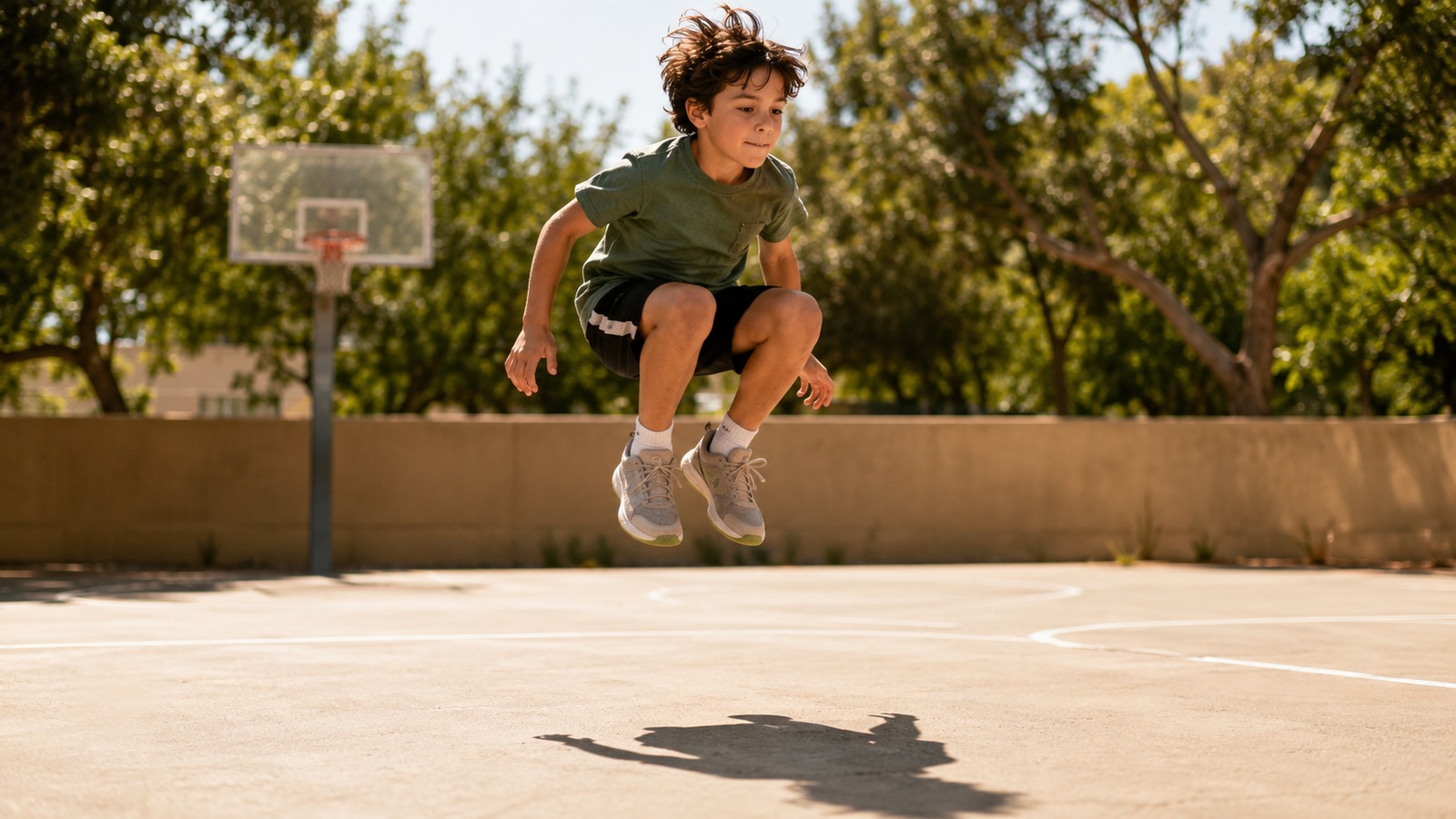
Minutes are only one layer. Walking and cycling build heart and lung fitness; running and games build coordination; climbing and resistance build muscle; jumping and sharp changes of direction load the skeleton; free play builds movement skills structured drills miss. A good week is a mix, and it can't be reduced to a single number.
Some is always better than none. Health benefits appear well below the full guideline,[3] so a child who does little today should add small amounts and build up frequency, duration and intensity — not leap to an hour a day.
1. The practical target — a week, not a day
For most healthy children aged 5–17, a strong week looks like:
About 420 minutes of moderate-to-vigorous activity across the week — including vigorous, muscle-strengthening and bone-loading activity on at least three days.
That 420 is just the seven-day equivalent of “60 minutes a day averaged out.” It isn’t a rigid prescription or a ceiling; it’s a shape to aim the week toward.
| Day | Main activity | Active time | Bone / muscle loading? |
|---|---|---|---|
| Monday | Active play, cycling, playground | 55 min | Climbing, running |
| Tuesday | Football or basketball | 75 min | Vigorous impact |
| Wednesday | Walking, games, short strength circuit | 50 min | Muscle strengthening |
| Thursday | Swimming and active play | 60 min | Low-impact aerobic |
| Friday | Tag, skipping, jumping | 55 min | Bone loading |
| Saturday | Sport, hiking or long outdoor play | 90 min | Mixed loading |
| Sunday | Easy cycling, walking, mobility | 35 min | Recovery |
| Weekly total | 420 min | ≥ 3 loading days |
This child never hits exactly 60 minutes on any single day — yet the weekly average meets the guideline and the loading days are covered.
2. Does a five-year-old need the same as a fifteen-year-old?
The broad public-health target is the same across ages 5–17 — but the activity should look completely different. A five-year-old is building basic movement skills in short bursts; a fifteen-year-old can sustain longer sessions, handle real resistance and train within structured sport. Same rough volume, very different delivery, supervision, intensity and recovery.
Around age five, build it out of play. Running and chasing, playground climbing, hopping and skipping, throwing and catching, riding a bike or scooter, dancing, swimming, jumping low obstacles. Sessions shouldn’t feel like exercise — five to fifteen minutes of energetic play, a quiet spell, then another burst. The priorities are enjoyment, movement variety, balance and coordination, confidence, safe landing skills, and frequent chances to move. A five-year-old needs none of an adult endurance plan or formal heavy lifting.
Around age fifteen, structure becomes useful. Team sport, running, swimming, martial arts, dance, sprinting, plyometrics, cycling, racket and court sports — and supervised resistance training, which is considered appropriate for young people when technique, gradual progression and suitable equipment come first.[14][15] Programs typically start with manageable loads, one or two sets and controlled repetitions — not maximal lifting.
3. Moderate versus vigorous — intensity is about effort, not looks
Intensity is how hard the body is working, not how impressive the activity appears. The simplest gauge is the talk test:
Light activity helps cut sedentary time and aids recovery, but it doesn’t deliver the full cardiovascular or bone stimulus of harder movement. Moderate activity carries most of the weekly total. For bone specifically, vigorous, high-impact movement appears to be a more powerful signal than light or moderate activity alone.
4. Why 60 minutes of walking isn’t 60 minutes of jumping
Both are movement; they are not the same mechanical stimulus. Bone adapts most strongly when loading is greater than its usual daily load, applied rapidly, weight-bearing, varied in direction, separated by recovery, and repeated consistently over months. The skeleton is thoroughly used to walking. Jumping, sprinting, landing and sharp direction changes create higher, less familiar forces — and that unfamiliarity is much of the signal.
This does not mean an hour of jumping. Bone-loading sessions can be short.
Other paediatric trials find similar site-specific benefits from short jumping programs, though results vary by skeletal site, maturity, program design and adherence.[5][6] Across the exercise literature, the gains are modest but real — greater total-body, femoral-neck and spinal bone measures in children assigned to loading programs than in controls, especially at weight-bearing sites.[7][8]
5. Why more repetitions aren’t always better — and why rest matters
Bone cells don’t respond equally to every repeated impact. In animal-loading experiments, the skeleton becomes temporarily less responsive when many cycles are performed without a break; splitting the same total loading into shorter bouts with rest produced more bone formation than delivering it all at once,[10] and inserting just ten seconds of rest between low-magnitude cycles turned an otherwise weak stimulus into an osteogenic one.[11]
A practical bone-loading block folds into play rather than looking like a medical drill: 5–10 controlled jumps, 20–30 seconds of walking or rest, another 5–10 jumps in a different direction or landing style, two to four short sets.
Rest between sessions matters too. Bone, muscle, tendon and the nervous system adapt after the activity, not only during it. Three loading days a week gives repeated exposure without demanding hard impact daily — and a rest day means avoiding the same hard stimulus while staying generally active, not lying still. Something like: jumping and running one day, cycling or swimming the next, court sport, easy play, skipping and strength, outdoor sport, then a walking-and-recovery day. Online claims that a specific number of rest days is required overstate it — the rest-insertion research supports the concept that mechanosensitivity recovers with unloading, not one universal child schedule.
6. Consistency beats intensity — and a single big day can’t stand in for a pattern
Bone studies generally need months before differences become measurable; reviews suggest paediatric impact programs often need at least seven months to show clear change.[7][9] That makes consistency worth more than the occasional spectacular session.
This is exactly why a single daily score can mislead: it hides the difference between sustainable activity and occasional overload. The metrics that actually reflect a healthy week are the shape of it — active minutes across the week, number of active days, vigorous-activity days, bone-loading days, muscle-strengthening days, long sedentary stretches, and consistency held over several months.
7. When harder training stops helping
Up to a point, more intensity means a stronger fitness and bone stimulus — but benefit doesn’t rise forever with effort. Hard exercise helps when it’s technically controlled, matched to maturity, progressed gradually, supported by enough sleep and nutrition, balanced with recovery, and enjoyable enough to keep doing. It turns counterproductive when it brings persistent pain, repeated injury, exhaustion, disrupted sleep, lost appetite, fear of training, menstrual disturbance, low energy availability, or withdrawal from ordinary play.
8. The questions parents actually ask
How much activity does a child need?
Children aged 5–17 should average at least 60 minutes of moderate-to-vigorous activity per day across the week, with vigorous, muscle-strengthening and bone-loading activity on at least three days.[1]
Does it have to happen every single day?
Daily movement is ideal, but the guideline is a weekly average — not a pass-or-fail test for each date. The 2020 update deliberately moved away from treating 60 minutes as a strict daily minimum, because the evidence rests on average activity over time.[2]
Is an hour of gentle activity enough for everything?
It supports general health, but children should also include some vigorous, muscle-strengthening and bone-loading activity — light movement alone gives a weaker bone signal.[12]
How often should bone-loading happen, and does it need to be long?
At least three days a week is a practical target, and no — brief, high-quality impact bouts repeated consistently can improve bone acquisition.[4] Think 5–15 minutes of jumping, hopping, skipping or multidirectional sport inside a wider play session.
What counts toward the 60-minute average?
PE class, walking or cycling to school, active recess, playground time, sport practice, swimming, dancing, active chores, family walks, outdoor play and short activity breaks — it doesn't need to be one continuous block.
Is harder always better?
No. Some vigorous activity is valuable, but intensity without recovery, nutrition or enjoyment can cause harm. A varied, enjoyable pattern repeated week after week beats occasional extremes.
How this connects to the whole system
A week of movement isn’t one number — it’s a pattern with several dials: total minutes, how hard, how the skeleton is loaded, and how much recovery sits between. That’s the same reason a bone age, a height percentile or a single day’s step count means little alone: the signal is always in the relationship between the parts, followed over months. Move often, work hard sometimes, load bones and muscles regularly, and leave room to recover — that shape, held consistently, is what supports healthy growth.
Your child's activity, read as a week — not a nightly quota
GrowSense tracks the pattern that actually matters: active minutes across the week, vigorous days, bone-loading days and muscle-strengthening days — so a busy Tuesday never reads as a failure, and a genuinely quiet fortnight doesn't hide behind one big weekend. Not a stopwatch, but an honest picture of the shape of the week.
Explore GrowSenseThe parent takeaway
The “60 minutes every day” number is a weekly average, not a nightly test. Daily movement is ideal, but a strong week is the real goal: around 420 moderate-to-vigorous minutes, with vigorous, muscle-strengthening and bone-loading activity on at least three days. Age changes the format, not the rough volume — a five-year-old needs play and imagination, a fifteen-year-old needs structure and ownership. A few minutes of jumping can matter more for bone than an hour of walking, brief loading bouts with rest beat exhausting repetition, and consistency over months beats any single spectacular day.
So the question that helps your child is never “did we hit 60 minutes today?”
It’s “does the whole week — minutes, intensity, loading and recovery — add up to a pattern we can keep?”
A single day is a data point. The week is the habit.
References
A. How much activity — the guideline
- Bull FC, Al-Ansari SS, Biddle S, et al. World Health Organization 2020 guidelines on physical activity and sedentary behaviour. Br J Sports Med. 2020;54(24):1451–1462. PMID: 33239350.
- Chaput JP, Willumsen J, Bull F, et al. 2020 WHO guidelines on physical activity and sedentary behaviour for children and adolescents aged 5–17 years: summary of the evidence. Int J Behav Nutr Phys Act. 2020;17(1):141. PMID: 33239009.
- Janssen I, LeBlanc AG. Systematic review of the health benefits of physical activity and fitness in school-aged children and youth. Int J Behav Nutr Phys Act. 2010;7:40. PMID: 20459784.
B. Bone loading, jumping and accrual
- Fuchs RK, Bauer JJ, Snow CM. Jumping improves hip and lumbar spine bone mass in prepubescent children: a randomized controlled trial. J Bone Miner Res. 2001;16(1):148–156. PMID: 11149479.
- Johannsen N, Binkley T, Englert V, Neiderauer G, Specker B. Bone response to jumping is site-specific in children: a randomized trial. Bone. 2003;33(4):533–539. PMID: 14555256.
- Vlachopoulos D, Barker AR, Ubago-Guisado E, et al. The effect of a high-impact jumping intervention on bone mass, bone stiffness and fitness in adolescent boys. Arch Osteoporos. 2018;13(1):128. PMID: 30446875.
- Specker B, Thiex NW, Sudhagoni RG. Does exercise influence pediatric bone? A systematic review. Clin Orthop Relat Res. 2015;473(11):3658–3672. PMID: 26208606.
- Tan VP, Macdonald HM, Kim S, et al. Influence of physical activity on bone strength in children and adolescents: a systematic review and narrative synthesis. J Bone Miner Res. 2014;29(10):2161–2181. PMID: 24737388.
- Gunter KB, Almstedt HC, Janz KF. Physical activity in childhood may be the key to optimizing lifespan skeletal health. Exerc Sport Sci Rev. 2012;40(1):13–21. PMID: 21918458.
C. Intensity, rest and the loading response
- Sayers A, Mattocks C, Deere K, Ness A, Riddoch C, Tobias JH. Habitual levels of vigorous, but not moderate or light, physical activity are positively related to cortical bone mass in adolescents. J Clin Endocrinol Metab. 2011;96(5):E793–802. PMID: 21325463.
- Marin-Puyalto J, Mäestu J, Gómez-Cabello A, et al. Frequency and duration of vigorous physical activity bouts are associated with adolescent boys' bone mineral status. Bone. 2019;120:141–147. PMID: 30355511.
- Robling AG, Burr DB, Turner CH. Partitioning a daily mechanical stimulus into discrete loading bouts improves the osteogenic response to loading. J Bone Miner Res. 2000;15(8):1596–1602. PMID: 10934659.
- Srinivasan S, Weimer DA, Agans SC, Bain SD, Gross TS. Low-magnitude mechanical loading becomes osteogenic when rest is inserted between each load cycle. J Bone Miner Res. 2002;17(9):1613–1620. PMID: 12211431.
D. Youth resistance training — safety
- Faigenbaum AD, Kraemer WJ, Blimkie CJR, et al. Youth resistance training: updated position statement paper from the National Strength and Conditioning Association. J Strength Cond Res. 2009;23(5 Suppl):S60–S79. PMID: 19620931.
- Behm DG, Faigenbaum AD, Falk B, Klentrou P. Canadian Society for Exercise Physiology position paper: resistance training in children and adolescents. Appl Physiol Nutr Metab. 2008;33(3):547–561. PMID: 18461111.
This article is educational and does not provide medical diagnosis, treatment or an individual training prescription. Children with pain, joint or bone conditions, bone fragility, neurological conditions or significant movement limitations need individualised advice. If a hard-training child shows slowing growth, delayed or disrupted puberty, unusual fatigue or disordered eating, speak with a qualified paediatrician or paediatric sports-medicine specialist.