Growth science · Myths
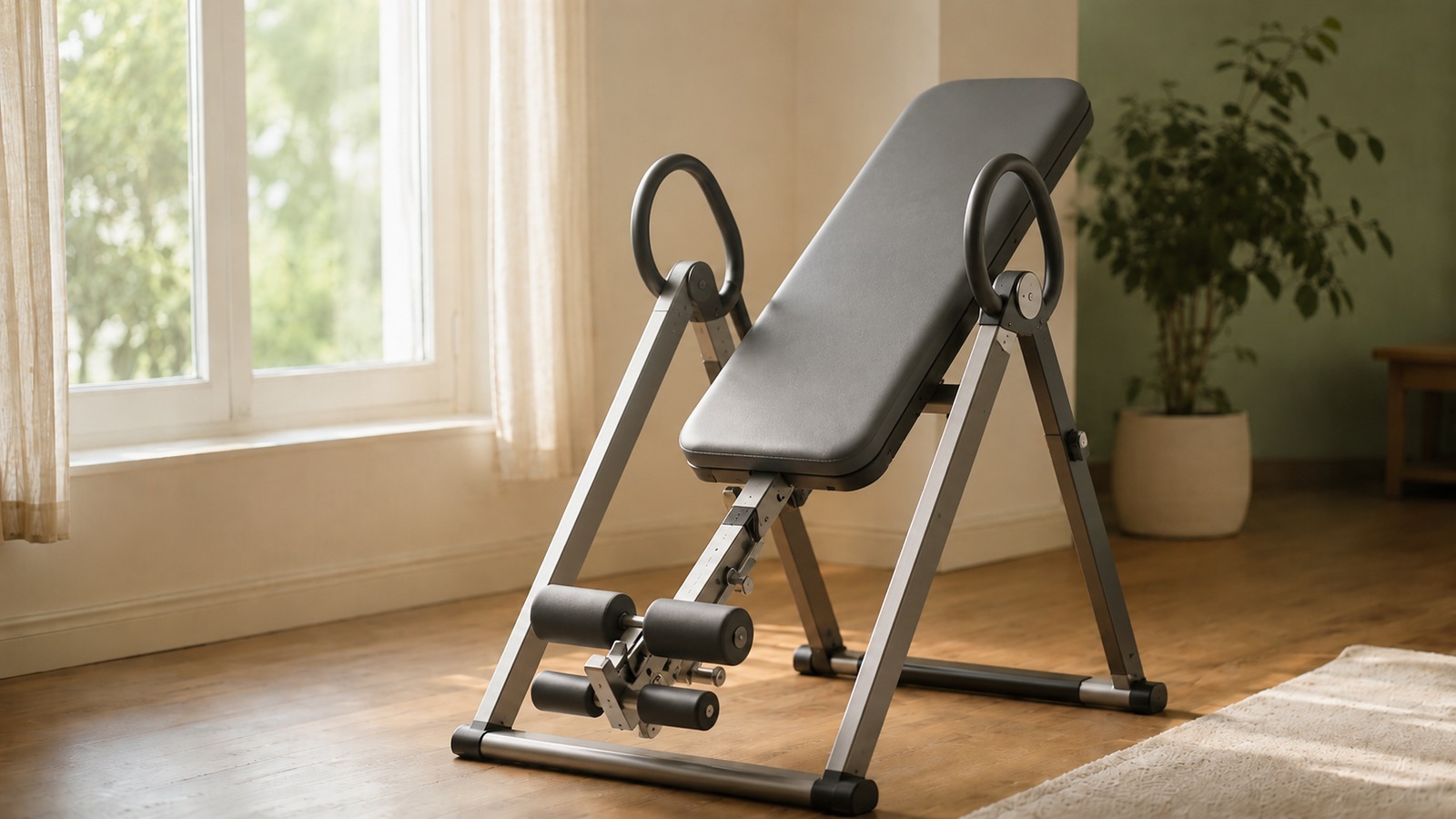
Do inversion tables make you taller? What hanging upside down actually does
Your teenager hangs upside down for twenty minutes, steps off, measures against the doorframe — and is a centimetre taller. They are not lying. They are not imagining it. You could measure it yourself, with a good stadiometer, and confirm every millimetre. They are also not growing.
Here’s the honest starting point: inversion tables work. That’s exactly why the myth is unkillable. Anyone who tries it gets immediate, physical, repeatable confirmation — and draws the wrong conclusion from a real result.
What the device actually does is borrow. Your spine compresses under your own weight all day and recovers overnight. Inversion just returns some of that height early. It borrows tomorrow morning’s centimetre and shows it to you tonight. Then gravity takes it back.
Where height actually comes from. Children get taller because cartilage at the growth plates — near the ends of the femur, tibia and other long bones — is steadily converted into new bone. That's it. Genetics, hormones, nutrition and puberty all act on that one process.
What traction pulls on. The spine — specifically the soft, water-rich discs between the vertebrae. A traction force separates and rehydrates structures that are already there.
Why that gap is the whole article. No amount of pulling on the spine reaches a growth plate in a leg. The device operates on a completely different part of the body from the one that decides your height.
Want the biology? How growth plates work, and when they close for good, is covered in When do children stop growing?
1. It works — for about an hour
We can be precise about this, because it’s been measured properly.
In a controlled experiment, eight men performed a set of drop jumps — which compressed their spines by about 1.7–1.8 mm — and then either stood or used gravity inversion for 20 minutes. Inversion increased stature by 5.18 mm. Standing increased it by 0.76 mm.[1]
So the effect is real, statistically solid, and roughly seven times better than just standing there. Then:
The researchers’ own conclusion, in their words: the effects of an inversion treatment are short-lasting.[1]
2. You shrink every day, whether or not you own a device
Inversion isn’t doing anything exotic. It’s accelerating a cycle your body runs regardless.
Stature follows a circadian pattern: you lose height during waking activity and recover it lying down.[6] The discs between your vertebrae are water-rich; daytime loading squeezes fluid out, and rest lets it back in. MRI work has tracked disc volume and water content changing across the day,[7] confirmed that disc composition itself is sensitive to diurnal variation,[9] and shown that fluid movement differs by spinal level and by region within each disc.[10] Measured stature change tracks measured disc dimension change.[8]
How big is this? In one MRI study, young adults regained an average of 19.3 mm overnight — with individuals ranging from 8 to 26 mm.[7]
This is also why measurement timing matters more than equipment, which we cover in How to measure your child’s height accurately at home.
3. “Stretching machine” is a marketing phrase, not a category
Before going further: when parents search for a “stretching machine”, they may mean any of about eight unrelated products. They are not biologically equivalent, and lumping them together is how the marketing works.
| Sold as | What it actually does | Effect on height |
|---|---|---|
| Inversion table | Head-down position creates gravity-assisted spinal traction | Temporary spinal recovery |
| Motorised decompression table | Applies controlled traction via belts or harnesses | Temporary disc spacing / hydration change |
| Lumbar traction machine | Pulls pelvis and upper trunk apart | Temporary spinal unloading |
| Cervical traction device | Applies pulling force to the neck | No meaningful height effect |
| Back-stretching bench | Places the trunk in flexion or extension | Temporary posture / spinal-height change |
| Full-body stretching machine | Holds limbs or trunk in prolonged stretch | Flexibility — not longer bones |
| Leg-stretch / split machine | Increases hip-adductor range of motion | None. Does not lengthen femur or tibia |
| Posture-correction machine | Encourages a more upright stance | May reveal existing height; creates none |
Only the top three do anything measurable to stature at all — and what they do is unload the spine. The bottom five are sold under phrases like height stretching machine or grow taller equipment while doing nothing to height whatsoever.
Stretching a muscle is not stretching a bone. When a physiotherapist says stretching “lengthens” a tight muscle, they mean your joint moves through a greater range — via stretch tolerance, nervous-system response and tissue mechanics. Your femur is exactly as long as it was. A leg-stretch machine may help a child achieve a wider split. It cannot add a millimetre to the bone doing the splitting.
4. The traction machines: bigger numbers, identical ceiling
Motorised traction pulls harder than gravity, so it moves the number more. It still can’t reach a growth plate.
Twenty-five minutes of mechanical lumbar traction increased stature by 8.94 mm, versus 3.33 mm for simply lying in a supported position — with the fastest change in the first 15 minutes.[2] MRI confirms the mechanism is genuine: traction can increase the height of some lower lumbar discs, though the response isn’t uniform across every disc or person.[3] Ten minutes in a hyperextended position also restores measured spinal height,[4] and brief hyperextension produces immediate stature increases.[5]
Every one of these findings is real. Every one of them describes the spine responding mechanically to load being removed — never bone being made.
5. Medical traction is real — which is exactly why the marketing works
Here’s the honest complication, and it’s what gives these devices their borrowed credibility: spinal traction is a legitimate clinical modality. It just isn’t a height treatment.
A small randomised pilot in adults with single-level lumbar discogenic disease found fewer inversion-assigned patients proceeded to surgery — though the sample was small and the authors framed it as a feasibility trial.[11] A later observational registry study also reported lower surgery rates among selected patients, but a non-randomised comparison can’t carry the weight of a controlled trial.[12]
So: some evidence, in adults, for a specific disc condition, from small studies. That’s the real indication. Notice what it isn’t — a claim about children, or about height, in either paper.
6. The risk nobody puts in the advertisement
This is the part that matters most, and it’s absent from every product page.
Inversion doesn’t just unload your spine — it sends blood to your head, and the eye is where that shows up first.
That last line isn’t our interpretation. It’s the paper’s own clinical instruction.[14] Related work documented ocular effects of gravity inversion more broadly.[15] Beyond the eye, inversion produces measurable cardiovascular and haemodynamic changes,[16] and ultrasound assessment during inversion-table tilt found changes in cerebral blood flow and estimated intracranial pressure, leading those authors to warn that complications may be possible in susceptible users.[17] A rehabilitation safety review noted rising injury reports involving non-powered traction devices and called for clearer safety standards.[13]
7. Should a child use one? No
Look at who the research studied: adults. The stature experiments used adult men in occupational and biomechanical settings.[1][2] The back-pain trials were adults.[11][12] The eye and circulation studies were adults.[14][18] Home inversion equipment is regulated as non-powered traction apparatus intended for adults — not as a growth device, and not for children.
There is also the plain mechanical problem: a child may simply not fit. Ankle restraints and adjustment mechanisms sized for adults can allow slipping, or concentrate force around a child’s ankles and knees.
A child should never use adult inversion equipment to get taller. If a child genuinely needs traction, it should follow a specific medical indication with clinical supervision.
Ordinary play — climbing, swimming, gymnastics, a minute hanging off the monkey bars — is a different thing entirely, and it’s fine. What movement does and doesn’t do for height is covered in Can exercise make children taller?
8. “But I gained half an inch in three weeks”
These reviews are usually honest. They’re just not measuring what the writer thinks.
They measured right after. A reading taken immediately post-inversion captures temporary unloading — then gets compared against an ordinary evening height. That’s not a before-and-after; it’s two different conditions.
They measured at a different hour. Morning versus evening alone can move the number by more than the device does.[6][7]
Their posture improved. Someone who stood with a forward head and soft knees now stands up straight. That’s real, and it’s worth having — but it reveals existing height rather than creating new height. See Can exercise make children taller? for why posture and bone length are different things.
They kept the best number. Measure five times, remember the tallest.
They’re a child. A growing child gains height during any three-week window. Without a control, the calendar gets credited to the machine.
9. The microfracture myth — and the surgery that actually does it
One claim online deserves a direct answer, because acting on it can hurt a child: that repeated impact or aggressive stretching creates “microfractures” that heal longer.
That misreads bone biology. Bone does remodel under load — but remodelling changes density, strength and architecture, not the length of an intact long bone.
Height can be added surgically. Distraction osteogenesis deliberately divides a bone and separates the ends by fractions of a millimetre a day while new bone forms in the gap. That is major orthopaedic surgery with specialist supervision, months of rehabilitation and real complication risk. It is not stretching, and no home device does a gentle version of it.
10. How this connects to the whole system
The reason this myth is worth 2,000 words isn’t that inversion tables are dangerous to your growth chart. It’s that they’re a perfect case study in the thing that makes growth so easy to get wrong: a real, measurable number that means nothing.
Five millimetres is genuinely there. You can measure it. It’s also gone by bedtime, and it says nothing about how tall that child will be at twenty. The same trap catches parents who measure at different hours, who read a growth spurt into three weeks of data, or who compare two hospitals’ bone-age readings as though they came from the same ruler.
The signal was never a single number. It’s the direction the number travels, over enough time for real biology to outrun the noise.
Do inversion tables make you permanently taller?
No. Inversion increased stature by about 5.18 mm in a controlled study, but 4.07 mm was lost within 40 minutes of standing, and by 30 minutes there was no significant difference from doing nothing at all.[1] The researchers concluded the effect is short-lasting. Nothing about the growth plates changes.
Does hanging from a pull-up bar do the same thing?
Partly, and less. Hanging unloads part of the spine, but much of your weight is still carried through the hands and shoulders, and muscle activity limits full relaxation. Same principle either way: decompression restores height that was temporarily lost — it doesn't create any.
Can a leg-stretching machine lengthen the legs?
No. It can increase hip flexibility and split range. The femur and tibia stay exactly the length they were. Stretching a muscle and stretching a bone are different things.
Is a stretching machine better than an inversion table?
For height, both are zero. Motorised lumbar traction moves the number more — about 8.94 mm after 25 minutes[2] — but it's the same temporary spinal unloading, and it still cannot reach a growth plate in a leg.
Is it safe for my child to try one?
Don't. The research is essentially all in adults, home inversion equipment is regulated as adult traction apparatus, and children may not fit the restraints safely. Inversion doubles intraocular pressure and raises blood pressure;[18] the ophthalmology literature explicitly recommends people with ocular hypertension or glaucoma avoid it entirely.[14] Real risk, impossible benefit.
My child measured taller right after hanging. Should I record it?
No — measure before sport, hanging or stretching, not after, and stick to your usual time of day. A post-unloading reading can imitate more than a month of real growth and will produce a false spurt followed by a false stall. See How to measure your child's height accurately at home.
A real number that means nothing
Inversion is a five-millimetre lesson in why growth tracking is hard: the measurement was honest and the conclusion was wrong. GrowSense records the time of day, the device and the spread across your readings, and grades how much a measurement can be trusted before it ever becomes a growth velocity — so a "spurt" is your child growing, not the hour, the hairstyle, or twenty minutes upside down.
Explore GrowSenseThe parent takeaway
Inversion tables and stretching machines are not a scam in the ordinary sense. They do what they say: your child really is a few millimetres taller when they step off. The measurement is honest.
The conclusion isn’t. Those millimetres came out of the spine’s discs, not the leg’s growth plates. They were going to come back overnight anyway — and your child’s bed returns nearly four times more of them, for free, every single night.[1][7]
What you’d be buying is doubled eye pressure and raised blood pressure, in exchange for borrowing a centimetre from tomorrow morning.
Let them sleep instead. It works better, and the research agrees.
References
What unloading actually does to stature
- Boocock MG, Garbutt G, Linge K, Reilly T, Troup JD. Changes in stature following drop jumping and post-exercise gravity inversion. Med Sci Sports Exerc. 1990;22(3):385–390. PMID: 2381307.
- Bridger RS, Ossey S, Fourie G. Effect of lumbar traction on stature. Spine (Phila Pa 1976). 1990;15(6):522–524. PMID: 2402690.
- Kourtis D, Magnusson ML, Smith F, Hadjipavlou A, Pope MH. Spine height and disc height changes as the effect of hyperextension using stadiometry and MRI. Iowa Orthop J. 2004;24:65–71. PMID: 15296209.
- Magnusson M, Pope MH. Body height changes with hyperextension. Clin Biomech (Bristol). 1997;12(4):236–238. PMID: 11415684.
Why height changes across the day
- Reilly T, Tyrrell A, Troup JD. Circadian variation in human stature. Chronobiol Int. 1984;1(2):121–126. PMID: 6600017.
- Roberts N, Hogg D, Whitehouse GH, Dangerfield P. Quantitative analysis of diurnal variation in volume and water content of lumbar intervertebral discs. Clin Anat. 1998;11(1):1–8. PMID: 9445091.
- Lewis SE, Fowler NE. Changes in intervertebral disk dimensions after a loading task and the relationship with stature change measurements. Arch Phys Med Rehabil. 2009;90(10):1795–1799. PMID: 19801073.
- Hamaguchi H, Kato H, Yokota H, et al. Quantitative Assessment of Intervertebral Disc Composition by MRI: Sensitivity to Diurnal Variation. Tomography. 2023;9(3):1029–1039. PMID: 37218944.
- Martin JT, Oldweiler AB, Kim J, et al. In vivo fluid transport in human intervertebral discs varies by spinal level and disc region. JOR Spine. 2022;5(2):e1199. PMID: 35783907.
Traction and the intervertebral disc
- Chow DHK, Yuen EMK, Xiao L, Leung MCP. Mechanical effects of traction on lumbar intervertebral discs: A magnetic resonance imaging study. Musculoskelet Sci Pract. 2017;29:78–83. PMID: 28347933.
Inversion for back pain — the real indication
- Prasad KSM, Gregson BA, Hargreaves G, Byrnes T, Winburn P, Mendelow AD. Inversion therapy in patients with pure single level lumbar discogenic disease: a pilot randomized trial. Disabil Rehabil. 2012;34(17):1473–1480. PMID: 22263648.
- Mendelow AD, Gregson BA, Mitchell P, Schofield I. Lumbar disc disease: the effect of inversion on clinical symptoms and a comparison of the rate of surgery after inversion therapy with the rate of surgery in neurosurgery controls. J Phys Ther Sci. 2021;33(11):801–808. PMID: 34776613.
Safety: eyes, blood pressure and the brain
- Weinreb RN, Cook J, Friberg TR. Effect of inverted body position on intraocular pressure. Am J Ophthalmol. 1984;98(6):784–787. PMID: 6507552.
- LeMarr JD, Golding LA, Adler JG. Intraocular pressure response to inversion. Am J Optom Physiol Opt. 1984;61(11):679–682. PMID: 6517124.
- Friberg TR, Weinreb RN. Ocular manifestations of gravity inversion. JAMA. 1985;253(12):1755–1757. PMID: 3974054.
- Jennings T, Seaworth J, Howell L, Tripp L, Goodyear N. Effect of body inversion on hemodynamics determined by two-dimensional echocardiography. Crit Care Med. 1985;13(9):760–762. PMID: 4028772.
- Kondrashova T, Makar M, Proctor C, Bridgmon KA, Pazdernik V. Dynamic assessment of cerebral blood flow and intracranial pressure during inversion table tilt using ultrasonography. J Neurol Sci. 2019;404:150–156. PMID: 31398694.
- Kassay A, Toth C, Chan V, Pichora D. Recommendations for inversion table therapy. Disabil Rehabil. 2023;45(22):3779–3782. PMID: 36444821.
This article is educational and does not provide medical diagnosis or treatment, and nothing here should be read as clearance to use an inversion or traction device. Inversion measurably raises intraocular and blood pressure and is not suitable for everyone; the published research on it is almost entirely in adults. Any traction for a child should follow a specific medical indication and be supervised by a qualified clinician. If your child has an eye, heart, blood-pressure, circulatory or bone condition — or you are unsure — ask a doctor before they use any such device.