Growth science · Myths
Does Caffeine or Coffee Stunt a Child's Growth?
For generations, children have been told: "Don't drink coffee — it'll stunt your growth." The claim sounds scientific: coffee has caffeine, caffeine affects the nervous system, some research links heavy caffeine to bone metabolism — therefore coffee must make children shorter. But that last step isn't supported by good human evidence. There's no convincing evidence that an occasional caffeinated drink closes a child's growth plates, permanently suppresses height, or lowers adult stature.[3][4]
That does not make caffeine harmless. Its most credible growth-related risk in children is indirect: it can delay bedtime, cut sleep duration and depth, raise anxiety and heart rate, feed a tiredness-then-caffeine cycle, and crowd out milk, water or meals — and energy drinks can deliver a large dose fast.[2]
The myth is wrong in mechanism. Caffeine has not been shown to directly stunt a healthy child's height; a Mendelian-randomization analysis found no causal link between caffeine and lower bone mineral density in youth.[9]
But it points at a real caution. Regular or late-day caffeine disturbs the sleep, nutrition and routines that support normal growth — and the sleep evidence is far clearer than any height evidence.[6]
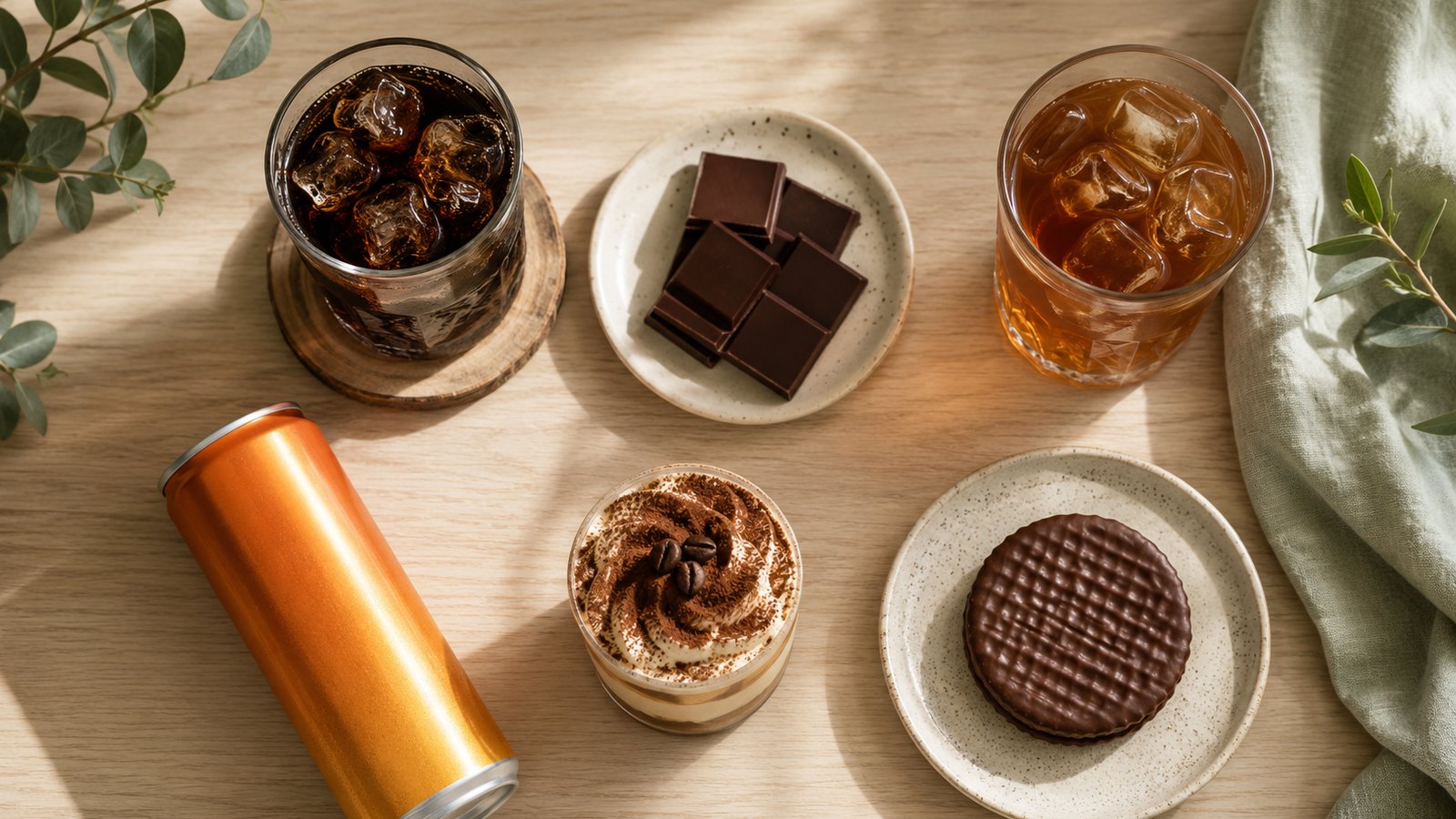
The dose hides. Caffeine lurks in chocolate, tea, cola, coffee desserts, energy and protein products, gum and some medicines — and energy drinks deserve a separate warning entirely.
1. What caffeine actually does
Caffeine is a stimulant. Its main immediate action is to block adenosine receptors in the brain. Adenosine builds up across waking hours and creates sleep pressure — the biological nudge that it’s time to rest. Blocking it makes a child feel more awake even when the body still needs sleep,[1] alongside a faster heart rate, restlessness, anxiety, headache, stomach upset or trouble falling asleep.
Children can feel effects at lower absolute doses than adults because they’re smaller: a 75 mg drink is about 1 mg/kg for a 75 kg adult but 3 mg/kg for a 25 kg child. Sensitivity also varies — and the absence of obvious hyperactivity does not prove sleep is unaffected.[2]
2. Where the myth came from
The old story likely braids together several separate observations:
- Confounding in adults. Heavy coffee drinking historically travelled with smoking and poor diet — behaviours that affect bone — making caffeine alone hard to blame.[4]
- A small calcium effect. Caffeine can slightly raise urinary calcium and modestly reduce absorption. In a child with adequate calcium this is unlikely to stop skeletal development — it matters more when caffeinated drinks replace calcium-rich foods.
- Displacement, not destruction. A cola at every meal may matter more because it displaces milk or water than because caffeine attacks the growth plate. A long-term study found less favourable bone outcomes with both caffeinated and caffeine-free soft drinks — implicating the overall beverage pattern, not caffeine alone.[11]
- Animal doses are enormous. Young-rat studies show very high caffeine can disturb growth-plate cartilage and longitudinal bone growth.[12] These explore mechanism at exposures far beyond a child eating chocolate — they’re a reason not to dismiss extreme intake, not proof the coffee myth holds at ordinary levels.
3. What human growth research actually shows
Direct research linking caffeine to final height in children is limited. A large analysis found associations between caffeine exposure and bone measurements, but genetic-instrument (Mendelian-randomization) analysis did not support a causal relationship — the authors called for more long-term pediatric study.[9][10] Other observational studies tie caffeine to height, weight, mood or sleep but can’t show direction: a teen who sleeps badly may use more caffeine because they’re tired, and the caffeine then worsens the sleep. Diet, screens, activity and family circumstances all cluster together.
There is no robust trial showing “children assigned to coffee became several centimetres shorter as adults” — such a trial would be difficult and ethically dubious. So the evidence supports caution about sleep, cardiovascular symptoms and high-dose products — not a precise caffeine-related centimetre loss.
4. The stronger concern: sleep
The caffeine–sleep link is far clearer than any caffeine–height link. In caffeine-consuming adolescents, researchers have documented later bedtimes and reduced slow-wave activity (a marker of sleep depth).[5] Studies across school-age children and teens associate more caffeine with shorter sleep, more sleep problems, greater daytime sleepiness, later bedtimes and poorer sleep quality — most concerning when it’s consumed later in the day.[6][7][8]
Why that touches growth: a major growth-hormone pulse commonly follows sleep onset, tied to deep slow-wave sleep, and disrupting that sleep can alter the normal release. But this does not let anyone calculate “one cola at dinner costs 0.2 cm.” A single poor night doesn’t stop growth, and there’s no evidence occasional caffeine permanently blocks GH. The concern is the repeated pattern — the honest mechanics of the sleep–GH link are in does sleep affect height:
5. Caffeine hides where parents don’t look
Many parents scan only for coffee and energy drinks. But the US FDA notes caffeine can appear in energy or protein bars, ice cream, gum, supplements and over-the-counter medicines — and when it comes naturally from an ingredient like chocolate, the word “caffeine” may not appear separately in the ingredient list at all.
| Hidden source | What surprises parents |
|---|---|
| Chocolate & cocoa | Cocoa carries caffeine (and theobromine); dark > milk (~24 mg per oz of 60–69% dark, per USDA data). Chocolate-coated coffee beans stack chocolate and coffee. |
| Tea | Black, green, oolong, matcha, bottled iced tea, bubble/Thai milk tea, matcha desserts, kombucha. Matcha can beat brewed green tea because the leaf is consumed, not discarded. |
| Cola & "pepper" sodas | "Sugar-free" and "zero" don't mean caffeine-free; child-friendly flavours and bottles hide it. |
| Coffee-flavoured desserts | Tiramisu, coffee jelly, mocha cake, coffee ice cream, affogato — real coffee even when it doesn't taste strong. |
| Energy & "performance" products | Caffeine often arrives as guarana, kola nut, yerba mate, green-tea or coffee-bean extract — a "natural botanical blend" is still caffeine (USDA notes these add caffeine). |
| Medicines | Some headache/migraine, cold and alertness products, and pre-workout supplements. |
A small chocolate snack is not an energy drink — but a chocolate dessert, a cola, a milk tea and a chocolate snack in one evening can add up in a small body without anyone noticing the total.
6. The marketing problem
Caffeine products are never advertised as “this stimulant may delay your bedtime.” They’re sold with energy, focus, performance, natural, zero sugar, hydration, gamer fuel, study support — a health halo around a stimulant. A few translations parents can keep in mind:
- “Energy” isn’t calories. In nutrition, energy means kilojoules; in advertising it means stimulation. A sugar-free energy drink has almost no calories but still activates via caffeine — that’s reduced perception of tiredness, not new fuel.
- “Natural caffeine” is still caffeine. Caffeine from guarana or green-tea extract blocks adenosine exactly like coffee’s — “natural” tells you nothing about total dose, absorption speed, or whether several caffeine ingredients are combined.
- Vitamins don’t cancel the stimulant. Added B vitamins don’t neutralize caffeine’s sleep or cardiovascular effects.
- Sports imagery misleads. Sports drinks are water, carbohydrate and electrolytes; energy drinks are stimulant products. And an influencer downing an energy product never shows the dose, their body size, the day’s other caffeine, or the disrupted sleep afterward.
7. Energy drinks deserve a separate warning
Energy drinks are not just strong sodas. They combine caffeine with sugar, guarana and other active ingredients, and can be drunk fast. Reviews of reported pediatric events describe cardiovascular, neurological and behavioural complications — worse when combined with exercise, illness or other stimulants — and experimental work has found raised 24-hour blood pressure after acute energy-drink intake in healthy minors.[14]
8. How much is “safe” — and when timing matters more
There’s no universally accepted pediatric limit. Some risk assessments propose around 2.5–3 mg/kg/day, but those are ceilings for assessment, not targets to aim for, and sleep effects can occur below them — especially in children who rarely have caffeine or who take it late.[4]
| Child's weight | 2.5 mg/kg (a ceiling, not a goal) |
|---|---|
| 20 kg | 50 mg |
| 25 kg | 62.5 mg |
| 30 kg | 75 mg |
| 40 kg | 100 mg |
| 50 kg | 125 mg |
Practical family guidance: young children should generally avoid deliberately caffeinated drinks; energy drinks should be avoided by all children and adolescents; caffeine should never be used to paper over inadequate sleep; and teens who do have it should keep it modest, infrequent and early in the day.
9. Questions parents actually ask
Does coffee directly stunt growth?
There's no convincing human evidence that ordinary coffee makes a child shorter or closes the growth plates.[9]
So caffeine is harmless for kids?
No. It can disturb sleep, cause anxiety and palpitations, and create a tiredness–caffeine cycle or dependence.[2]
What's the real growth-related concern?
The indirect path: caffeine can erode the sleep quality and routine that support normal growth and recovery.[6]
Does caffeine weaken children's bones?
Evidence in children is mixed; high-dose animal studies raise concerns, but pediatric human research hasn't shown a causal drop in bone density from ordinary intake.[9][12]
Does it affect puberty?
The evidence isn't strong enough to say ordinary caffeine changes pubertal timing; genetics, nutrition and health matter far more (see do foods cause early puberty).
Can a child get dependent?
Yes — regular use brings tolerance and withdrawal (headache, fatigue, irritability), so a child may use caffeine just to avoid feeling worse. Taper rather than stop abruptly if intake is high.
Are energy drinks ever okay for children?
No — they deliver high stimulant doses with no benefit a child needs.[13]
How this connects
Caffeine is a tidy example of a myth that’s wrong on mechanism but right to worry about — just for a different reason than the playground version. It won’t close a growth plate, but it can quietly erode sleep, and sleep is where a real chunk of growth-hormone release happens. As with every growth question, the signal isn’t a single scary number (“this cola cost 0.2 cm” — uncomputable); it’s a pattern over time: caffeine creeping later, bedtimes slipping, mornings getting harder. Treat a tired child as information — the fix is usually more sleep or a cause found, not a stimulant to mask it.
Keep caffeine in the sleep-and-nutrition picture — not a height calculator
GrowSense records caffeine where it belongs: the product and rough serving, the time it was consumed, and the hidden-source category — set against bedtime, sleep onset, night waking and morning tiredness, so a late-caffeine-then-restless-night pattern becomes visible across a week. What it won't do is claim "this drink cut tonight's growth hormone by 20%" — that isn't measurable from a food log or a wearable. Instead it flags the honest thing: caffeine logged at 5:30 p.m. on four evenings alongside later sleep — consider moving it earlier or swapping it out.
Explore GrowSenseWhat parents should take away
Coffee doesn’t appear to steal centimetres directly — the growth-plate version of the myth isn’t supported in humans. But caffeine can steal sleep, and repeated lost sleep is a poor trade for a growing child. Watch the hidden sources (chocolate, tea, cola, coffee desserts, energy and “performance” products, some medicines), keep it early and modest for teens, keep it away from younger children, and keep energy drinks away from children entirely. And when a child is always tired, don’t reach for caffeine — find out why they’re tired.
References
A. Reviews and safety guidance
- Temple JL. Caffeine use in children: what we know, what we have left to learn, and why we should worry. Neurosci Biobehav Rev. 2009;33(6):793–806. PMID: 19428492.
- Temple JL, Ziegler AM, Martin C, et al. Review: Trends, Safety, and Recommendations for Caffeine Use in Children and Adolescents. J Am Acad Child Adolesc Psychiatry. 2019;58(1):36–45. PMID: 30577937.
- Torres-Ugalde YC, Romero-Palencia A, Román-Gutiérrez AD, et al. Caffeine Consumption in Children: Innocuous or Deleterious? A Systematic Review. Int J Environ Res Public Health. 2020;17(7):2489. PMID: 32260589.
- Ruxton CHS. The suitability of caffeinated drinks for children: a systematic review of randomised controlled trials, observational studies and expert panel guidelines. J Hum Nutr Diet. 2014;27(4):342–357. PMID: 25099503.
B. Caffeine and sleep
- Aepli A, Kurth S, Tesler N, et al. Caffeine Consuming Children and Adolescents Show Altered Sleep Behavior and Deep Sleep. Brain Sci. 2015;5(4):441–455. PMID: 26501326.
- Watson EJ, Banks S, Coates AM, Kohler MJ. The Relationship Between Caffeine, Sleep, and Behavior in Children. J Clin Sleep Med. 2017;13(4):533–543. PMID: 28162144.
- Jessel CD, Narang A, Zuberi R, et al. Sleep Quality and Duration in Children That Consume Caffeine. Genes (Basel). 2023;14(2):289. PMID: 36833216.
- Orbeta RL, Overpeck MD, Ramcharran D, et al. High caffeine intake in adolescents: associations with difficulty sleeping and feeling tired in the morning. J Adolesc Health. 2006;38(4):451–453. PMID: 16549311.
C. Caffeine, bone and growth
- Cui A, Xiao P, Fan Z, et al. Association between caffeine consumption and bone mineral density in children and adolescents. PLoS One. 2023;18(6):e0287756. PMID: 37384670.
- Luo J, Wang H, Chen S, et al. Association of urinary caffeine and caffeine metabolites with bone mineral density in children and adolescents. Medicine (Baltimore). 2022;101(49):e31984. PMID: 36626464.
- Libuda L, Alexy U, Remer T, et al. Association between long-term consumption of soft drinks and variables of bone modeling and remodeling in a sample of healthy German children and adolescents. Am J Clin Nutr. 2008;88(6):1670–1677. PMID: 19064530.
- Choi H, Kim CH, Song JT, et al. Longitudinal bone growth is impaired by direct involvement of caffeine at the growth plate in young rats. J Anat. 2017;230(1):117–127. PMID: 27484046.
D. Energy drinks
- Seifert SM, Schaechter JL, Hershorin ER, Lipshultz SE. Health effects of energy drinks on children, adolescents, and young adults. Pediatrics. 2011;127(3):511–528. PMID: 21321035.
- Li P, Mandilaras G, Jakob A, et al. Energy Drinks and Adverse Health Events in Children and Adolescents: A Literature Review. Nutrients. 2023;15(11):2537. PMID: 37299498.
This article is educational and does not diagnose your child or assess their growth. It is not a recommendation to give children caffeine. Energy drinks are not appropriate for children and adolescents, and a child who is persistently tired needs the cause found — not a stimulant to mask it. If your child has palpitations, chest pain, fainting, severe anxiety or a possible reaction after a caffeinated or energy product, seek medical advice. Questions about a child's growth, sleep or diet belong with your pediatrician.