
Growth basics
Air pollution, PM2.5 & child growth
Dirty air can make the biological environment for growth less favourable — most clearly before birth and in early childhood — through inflammation, placental stress, illness, lost sleep and less outdoor play. Why it alters trajectories (sometimes stunting, sometimes weight gain) rather than shrinking a child, and how families can cut exposure.
Read the article →
Medical tests
Do asthma inhalers & steroids stunt growth?
Inhaled steroids can slightly slow growth — about half a centimetre in the first year, ~1.2 cm of adult height in the best long-term trial — dose-dependent and not lost every year. But under-treating asthma isn't growth-protective. How medicine, dose, duration and age change the balance.
Read the article →
Growth basics
Born small: SGA, prematurity, and who catches up
"Most small babies catch up" is true but incomplete. The words that sound alike but aren't (SGA, low birth weight, FGR, premature), when catch-up normally happens, why corrected age matters, and when persistent short stature needs specialist review — not indefinite waiting.
Read the article →
Activity
Can exercise make children taller?
Exercise builds stronger bones, not longer ones. The selection trap, which activities load bone most, the myths (basketball, jumping, swimming, hanging), and the real risk — under-fuelling.
Read the article →
Myths
Do foods cause early puberty?
Chicken, milk, soy — the three foods parents blame most. An honest, sourced answer: why the chicken-hormone story is a myth, what milk and soy really do, and the one factor that genuinely moves puberty earlier.
Read the article →
Myths
Do inversion tables make you taller?
They genuinely do — by about 5 mm, for roughly an hour. Why the effect is real but borrowed, what a “stretching machine” actually is, why traction can never reach the growth plates, and the eye-pressure risk nobody advertises.
Read the article →
Myths
Does caffeine or coffee stunt growth?
There's no convincing evidence coffee directly closes a child's growth plates or steals height. But caffeine can steal sleep — and it hides in chocolate, tea, cola, desserts, energy bars and supplements. What the evidence really shows, and how to read the labels that hide it.
Read the article →
Myths
Does milk make kids taller?
Milk supports growth — it doesn't create it. The real ~0.4 cm effect, why stronger bone isn't longer bone, the IGF-1 signal, plant-based alternatives, and when milk actually helps.
Read the article →
Puberty
Early puberty & adult height
The tallest child at ten isn't always the tallest at twenty. Why early puberty speeds growth up while shortening its duration, how estrogen and bone age set the finish, and whether treatment can protect height.
Read the article →
Medical tests
Your child's growth blood tests, explained
IGF-1, TSH, vitamin D, ferritin — what each result actually means, why one number rarely explains slow growth, why ranges vary, and how the four connect as a single system. Digested for parents, sourced throughout.
Read the article →
Activity
How much exercise does a child actually need?
The '60 minutes every day' number is a weekly average, not a nightly stopwatch test. How age, intensity, bone-loading, rest and consistency change what an effective week looks like — and why a few minutes of jumping can matter more than an hour of walking.
Read the article →
Prediction
How tall will my child be?
How adult height is really predicted — genetics, mid-parental height, bone age, and pubertal timing — and why every estimate is a range, not a ceiling. The differentiator, done honestly.
Read the article →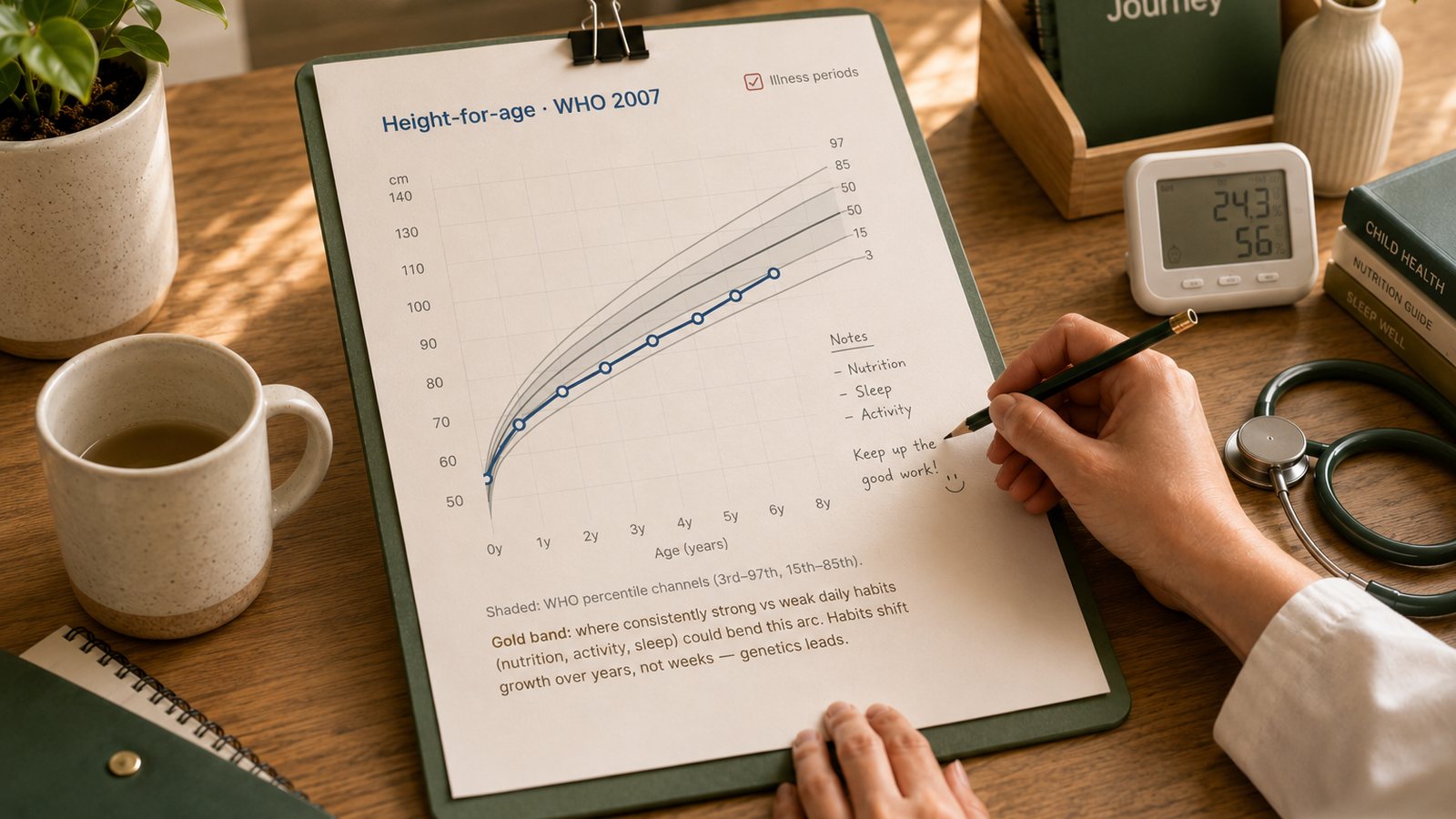
Growth basics
Normal height & weight by age: reading the chart
There's no single number every child should hit. What percentiles and z-scores really mean, why the 50th isn't a target, why the chart you choose changes the answer, and why the trajectory tells the real story.
Read the article →
Growth patterns
Why children grow faster in spring — and why 3 months mislead
Many children in temperate climates gain height faster in spring — but it's not a universal calendar rule, and a three-month reading distorts velocity badly. What actually drives seasonal growth, why the tropics differ, and why growth is a trajectory, not a snapshot.
Read the article →
Medical tests
Stress, cortisol & your child's growth
Ordinary worry doesn't stop a healthy child growing. But severe, persistent adversity can disrupt sleep, appetite and the GH–IGF-1 pathway — and in rare cases cause psychosocial short stature, where the hormone changes can reverse in a safer environment. When a slowing curve needs medical and safeguarding review.
Read the article →
Medical tests
Thyroid and your child's growth: how hypothyroidism slows height
An underactive thyroid slows height while weight holds or rises — one of the most treatable causes of growth failure. The tell-tale pattern, why the growth plate stalls, what catch-up looks like after treatment, and why it isn't always complete.
Read the article →
Nutrition
Vitamin D, sunlight, and your child's bones
Sunlight makes most of a child's vitamin D — yet sunny-city kids are still often low (indoor life, glass, skin tone, latitude, PM2.5). What it does for bone, why a food log looks low, why you can't convert sun into a dose, and why it protects growth without adding height.
Read the article →
Population trends
Why did Korean and Dutch children get so much taller?
Whole populations became dramatically taller — then stopped. What actually drove it (not milk, not genes changing), why it plateaus, earlier puberty vs a taller adult, and why K-pop and C-dramas exaggerate a real trend. Sourced throughout.
Read the article →
Sleep
Does sleep affect height?
Deep sleep, growth hormone, and the real signal: why the “before midnight” rule is a myth, why one late night won't cost height, and the one place sleep and growth truly meet — sleep apnea.
Read the article →
Growth basics
Growth charts around the world, by country
There's no single 'world' or 'Asian' chart. A country-by-country tour — WHO, CDC, China, Japan, Korea, India, Southeast Asia, Saudi Arabia, Europe — and why the reference you pick can move a child's percentile.
Read the article →
Nutrition
Which growth nutrition co-factors actually matter?
Calcium, vitamin D, zinc and iron all matter — but fixing a real deficiency is not the same as buying height. What the evidence says, safe intakes by age, and how to tell a genuine gap from clever marketing.
Read the article →
Prediction
When do children stop growing?
Growth ends when the growth plates fuse — driven by estrogen in both sexes — not on a birthday. Why bone age reads the remaining runway better than age, why it isn't the whole story, and what actually closes the window.
Read the article →
Growth basics
How to measure your child's height accurately at home
A 1 cm error hides three months of real growth — and your child is genuinely shorter tonight than this morning. A repeatable protocol, the three-reading rule, and why a careful parent can out-measure a rushed clinic.
Read the article →
Nutrition
Protein & height: does protein really help kids grow taller?
A Protein 101 for parents: what protein actually does, the IGF-1 pathway, quality vs. quantity, the milk question, and why protein is fuel to reach genetic potential — not a lever to exceed it.
Read the article →
Prediction
Why two hospitals can give different bone ages
One hospital says 8, another says 9 — and usually neither is wrong. Why Greulich–Pyle and TW3 are different rulers, how much variation is normal, why the atlas may not fit your child, and what to do when two reports disagree.
Read the article →
Reassurance
Is my child too short? When to actually worry
Most short children are perfectly healthy. How to read velocity, percentiles, and bone age — the real red flags, and the honest truth about growth-hormone treatment.
Read the article →
Height & velocity
Why do some children grow faster than others?
The science of growth velocity — and the six systems (genetics, hormones, sleep, nutrition, activity, bone age) that shape how your child grows.
Read the article →No articles match that search.
More growth-science guides coming soon.